


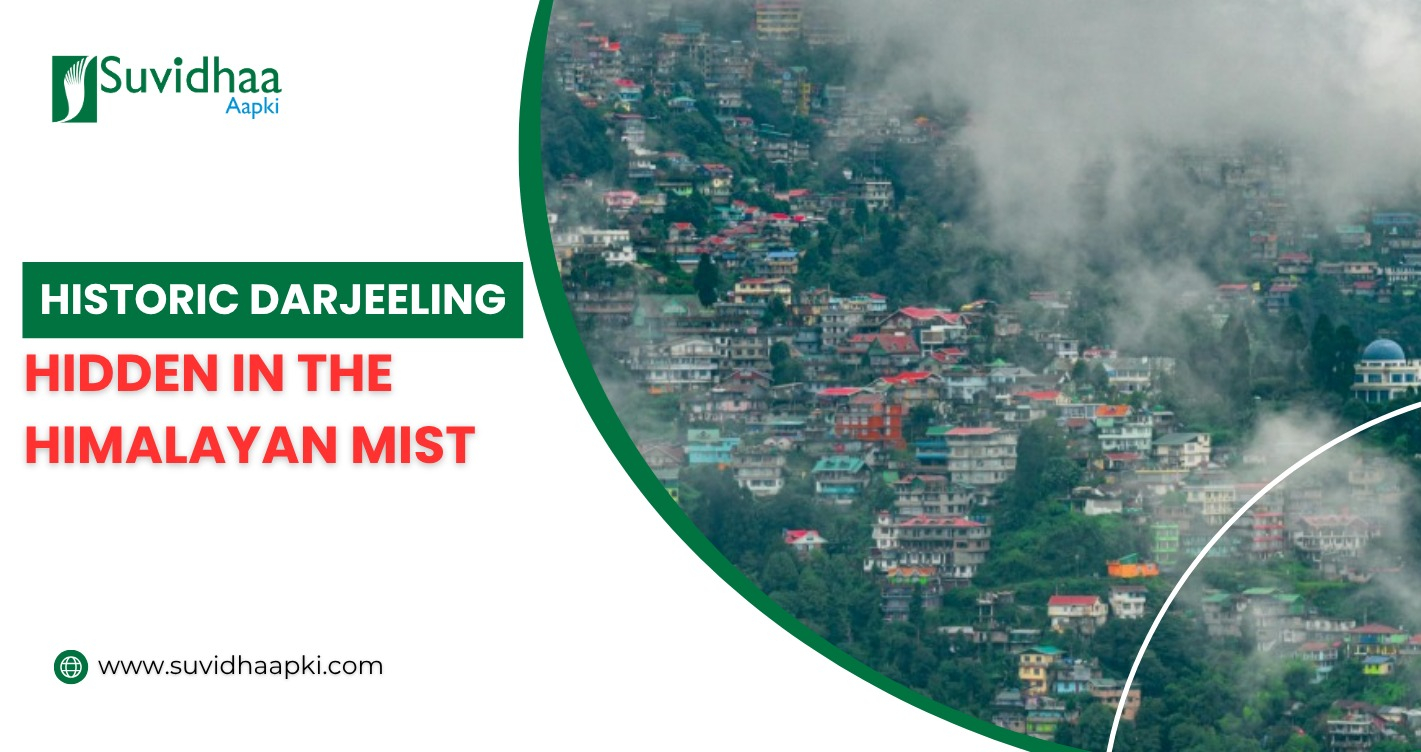
Most people come to Darjeeling for the tea, the mountain views, and the cool Himalayan air. But spend a few extra hours walking its steep, winding lanes and you will discover something far deeper — a town where history is not locked inside a museum. It is still alive and in use.
A steam locomotive built in the 1880s still hisses through the hills every morning. A Scottish church constructed during British rule still stands quietly on a green hilltop. Tea gardens planted over 150 years ago are still producing the world's finest leaves. These are not reconstructions or replicas — they are the real thing, still functioning, still inhabited, still breathing.
This guide takes you through the most significant historic places in Darjeeling that still exist today — what they are, why they matter, and exactly how to experience them. Many travellers planning a Darjeeling tour from Siliguri find that these heritage landmarks become the most memorable part of their entire hill trip.
"Darjeeling is one of those rare places where the past did not just survive — it stayed in use."
In the early 1800s, the British East India Company identified Darjeeling as a strategically valuable and climatically ideal retreat. Perched at over 6,700 feet in the Himalayan foothills of present-day West Bengal, it quickly became a prized summer destination for British officers escaping the heat of Calcutta.
What followed was a rapid transformation. Tea was introduced to the hillsides from the 1840s onwards. Churches, heritage schools, colonial bungalows, and stone market buildings were constructed in a distinctly European architectural style. Then in 1881 came the Darjeeling Himalayan Railway — one of the most ambitious engineering achievements of the entire colonial era — connecting the mountain town to the plains below.
At the same time, Darjeeling already carried deep Tibetan and Nepali cultural roots. Monasteries had existed in these hills for centuries before the British arrived. This collision of colonial ambition and ancient Himalayan heritage created a town with genuinely extraordinary historical depth — and the remarkable thing is that most of it is still standing today.
If there is one symbol of historic Darjeeling that has survived everything — two world wars, Indian independence, earthquakes, and over a century of mountain weather — it is the Darjeeling Himalayan Railway. Constructed between 1879 and 1881 by the British, this narrow-gauge mountain railway climbs from New Jalpaiguri in the plains all the way up to Darjeeling at over 7,000 feet.
In 1999, it received UNESCO World Heritage Site status — one of only three mountain railways in the world to hold this recognition. Several of its steam locomotives are over a century old and still run heritage joy rides along the most scenic sections of the route.
The railway uses a unique "Z-reverse" loop system to navigate extreme gradients — a 19th-century engineering solution that still works exactly as designed, more than 140 years later.
Watching the Toy Train crawl through narrow mountain lanes, past colourful houses and old stone bridges, is one of those travel experiences that feels genuinely timeless. Book your tickets well in advance during peak season. If you are comparing transportation options from Siliguri to Darjeeling, the heritage train experience is worth building your itinerary around.
Located at approximately 7,407 feet above sea level, Ghum (Ghoom) Railway Station is far more than a stop on the Toy Train route — it is a heritage destination in its own right. This compact, century-old station sits in quiet contrast to the dramatic Himalayan landscape surrounding it.
Beside the station is a small but genuinely fascinating railway museum housing vintage locomotives, historical photographs, and artefacts documenting the construction and history of the Darjeeling Himalayan Railway. For anyone with even a passing interest in colonial engineering history, this is one of the most rewarding and undervisited spots in the region.
Ghum is one of the highest railway stations in the Indian subcontinent. On clear winter mornings, the views of the surrounding Himalayan peaks from the station platform are absolutely spectacular.
Most visitors pass through Ghum on the joy ride without stopping. We strongly recommend stepping off and exploring — the area around the station has an authentic, unhurried atmosphere that feels very different from busy central Darjeeling, and the nearby Ghoom Monastery makes it a natural double heritage stop.
Perched on a quiet green hilltop, St. Andrew's Church is one of the most visually arresting historic buildings in Darjeeling. Built by Scottish settlers in the Gothic tradition, its white-washed walls, tall clock tower, pointed arched windows, and red-tiled roof create a scene that feels beautifully incongruous against the backdrop of the Himalayan hills.
The church's cemetery is a quiet piece of living history. Inscriptions on the old graves tell the personal stories of British officers, tea planters, missionaries, and their families who made Darjeeling their home during the 1800s. Walking through it feels like reading a forgotten chapter of colonial India — intimate, melancholic, and strangely moving.
The interior is equally atmospheric. Stone floors, polished wooden pews, and stained glass windows that filter the afternoon light into soft pools of colour make this a genuinely peaceful space. Even if you are not religiously inclined, St. Andrew's rewards a visit as a piece of living architectural and social history.
Ghoom Monastery (formally Yiga Choeling Monastery) is one of the oldest Tibetan Buddhist monasteries in the entire region, established in 1850 by Lama Sherab Gyatso. Belonging to the Gelugpa — or Yellow Hat — sect of Tibetan Buddhism, it sits quietly near Ghum town and welcomes visitors from around the world throughout the year.
The monastery's greatest treasure is its magnificent Maitreya Buddha statue — the Future Buddha — standing approximately 15 feet tall and surrounded by intricate Tibetan decorations, centuries-old thangka paintings, and ancient manuscripts. The combination of incense, candlelight, ceremonial objects, and devotional atmosphere makes visiting the interior a genuinely memorable and affecting experience.
Photography inside the prayer hall requires a small fee. Dress modestly, remove your shoes before entering, and maintain a quiet voice out of respect for the monks and worshippers present.
Ghoom Monastery also preserves rare Buddhist manuscripts and texts, some dating back centuries, that remain an important part of active religious scholarship. For anyone drawn to Tibetan cultural heritage, this is one of the most authentic and undisturbed sacred spaces accessible to travellers in the eastern Himalayas.
Established in 1878 during British rule, the Lloyd Botanical Garden is a beautifully maintained heritage landscape spread across roughly 40 acres on the slopes below Darjeeling town. Named after William Lloyd, who funded its creation, the garden was originally designed as a centre for botanical research and plant acclimatisation under the British Raj.
Today it houses an impressive collection of rare Himalayan plants, orchids, rhododendrons, ferns, and temperate-zone trees. The greenhouse section contains specimens that would have been of significant scientific interest to the naturalists and botanists of the colonial era. Walking through the garden feels like stepping into a quietly maintained piece of 19th-century natural science — thoughtful, ordered, and genuinely beautiful.
Lloyd Botanical Garden is also one of Darjeeling's best photography spots, particularly in the morning when mist drifts through the trees and the flower beds are at their freshest and most colourful.
Happy Valley Tea Estate is one of Darjeeling's oldest and most celebrated gardens, established in the 1850s during the early expansion of British tea cultivation in the Himalayan foothills. Situated close to the town centre, it is one of the few estates where visitors can take a guided tour of the complete tea production process — from fresh leaf plucking on the hillside to the finished product ready for export.
What makes Happy Valley particularly special is how little has changed over the decades. The original colonial-era processing factory still operates. The terraced garden plots still follow the same contours laid out over 150 years ago. The estate continues to produce award-winning first flush and second flush Darjeeling teas that travel to teacups in Europe, Japan, and across the world.
March to May is the ideal window. This is first flush season — when the youngest, most prized leaves are plucked and you can witness the entire production process in action from garden to factory floor.
Standing in these ancient tea gardens, with the Kanchenjunga massif occasionally visible through a break in the mist, is one of those travel moments that stays with you long after you have returned home.
Beyond the named heritage landmarks, Darjeeling is full of everyday British-era colonial architecture that rewards any visitor willing to slow down and look carefully. The town developed rapidly under British administration, and a remarkable amount of that built environment has survived into the present day.
Some of the finest examples include St. Paul's School (founded 1864), heritage bungalows clinging to the hillsides at dramatic angles, the stone-built market buildings of the old town, and the famous Elgin Hotel — a heritage property that has been welcoming guests since the Raj era. Mall Road itself retains much of its original colonial character, with stone walls, Victorian lamp posts, and the unhurried atmosphere of a British hill station that somehow survived the 20th century intact.
These are not museum exhibits — they are living, functioning parts of town. Local residents walk past century-old arched doorways every single day without a second glance. For a first-time visitor, the same details are endlessly fascinating.
If you are willing to go slightly beyond the standard sightseeing circuit, Darjeeling rewards you generously with layers of history that most visitors never reach.
Travellers wanting a well-structured plan for both the main landmarks and these hidden corners can explore our full Darjeeling 3-day itinerary from Siliguri, which covers the classic highlights alongside several off-the-beaten-path suggestions.
Darjeeling is not the kind of heritage destination that keeps everything behind glass or forces you to read about history from a signboard. Its past is tactile, atmospheric, and participatory. You can ride the same railway built in 1881. You can drink tea from gardens planted before your great-grandparents were born. You can sit quietly inside a monastery where monks have been chanting for over 170 years.
This is slow travel at its most satisfying — a destination that reveals more the longer you spend with it, and that connects the modern visitor to something genuinely ancient and enduring. Nowhere else on earth will you find Tibetan Buddhist culture, Scottish Gothic architecture, British colonial engineering, and Himalayan natural beauty all coexisting within a few square kilometres.
Best mountain views and heritage photography. Kanchenjunga is often perfectly visible at dawn.
Ideal for walking tours. Tea gardens are in full first flush swing — the most atmospheric season.
Monsoon mist through colonial buildings creates extraordinary moody photography opportunities.
Each season offers a genuinely different experience of Darjeeling's historic places. For full seasonal guidance and travel planning, visit the Darjeeling destination page on our website.
If you are travelling from the plains and want a comfortable, well-organised experience, explore our Darjeeling tour packages from Siliguri — planned specifically for heritage-focused Himalayan hill trips.
Everything you need to know before you visit.
The Darjeeling Himalayan Railway — built in 1881 and a UNESCO World Heritage Site — is the most iconic. Ghoom Monastery (established 1850) and St. Andrew's Church are equally significant landmarks for anyone interested in the region's cultural and architectural history.
Yes — fully operational. The Darjeeling Himalayan Railway runs both heritage joy rides and scheduled full-route services in 2026. Tickets can be booked through the Indian Railways official website or directly at Darjeeling or New Jalpaiguri station. Advance booking is strongly recommended during peak season.
Ghum (Ghoom) is one of India's highest railway stations, sitting at approximately 7,407 feet above sea level. It is a key stop on the Toy Train route and is home to a heritage railway museum. The nearby Ghoom Monastery makes it a natural double heritage visit.
Yes, extensively. St. Andrew's Church, The Elgin Hotel, St. Paul's School, Lloyd Botanical Garden, colonial bungalows, and numerous stone market buildings along Mall Road all date from the British era and remain in active use today.
The top heritage landmarks are: the Darjeeling Himalayan Railway, Ghoom Railway Station and Museum, St. Andrew's Church, Ghoom Monastery, Lloyd Botanical Garden, Happy Valley Tea Estate, and the colonial architecture along Mall Road. A guided heritage walk can cover most of these in a single full day.
There is something quietly extraordinary about a place where history did not simply survive — it stayed in use. Darjeeling's heritage buildings are not ruins. Its railway still runs. Its monasteries still welcome monks and meditators every morning. Its tea gardens still produce the leaves that end up in teacups across the world.
For anyone who believes that travel should connect you to something real and lasting, Darjeeling delivers that in abundance. Every steam engine whistle, every monastery bell, every stone building weathered by another season of Himalayan mist is a quiet reminder that some things were built to endure.
Whether you are visiting Darjeeling for the first time or returning to the hills, the town's historic places offer a perspective that goes far beyond the Instagram frame — and one that stays with you long after you have come back down to the plains. Explore our trusted travel planning guide from Siliguri to get started.
Let our team at Suvidhaa Aapki put together a comfortable, thoughtfully organised heritage tour that covers the best of Darjeeling at your own pace.
Historic Places in Darjeeling
That Still Exist Today
Why Darjeeling Has So Much History
Historic Places in Darjeeling That Still Exist Today
Darjeeling Himalayan Railway — The Legendary Toy Train

Ghum Railway Station — India's Iconic High-Altitude Station
St. Andrew's Church — Scottish Heritage in the Himalayas

Ghoom Monastery — A Living Piece of Tibetan Heritage

Lloyd Botanical Garden — Colonial Botany in the Hills
Happy Valley Tea Estate — Where Darjeeling Tea Was Born

Colonial Architecture Still Seen Across Darjeeling
Hidden Historic Spots Most Tourists Miss
Why History Lovers Should Visit Darjeeling
Best Time to Explore Historic Darjeeling
Travel Tips for Visiting Historic Places in Darjeeling
Frequently Asked Questions
Darjeeling's History Is Still Alive
Ready to Explore Historic Darjeeling?
Sikkim in Monsoon 2026: Is It Safe? Weather, Road Conditions &... Jun 19th, 2026